




























Skip to content
OFFER Use code on paid courses at checkout
FREE PREVIEW Week 3 3 lessons

Reasoning: Analytical and Non-Verbal

Statement and conclusion, assumption, course of action, cause and effect, data sufficiency, input-output, calendar and clock problems, and non-verbal reasoning such as mirror images, paper folding and counting figures.

Lessons in this module

1

Statements: Conclusions, Assumptions, Courses of Action, Cause and Effect

Lesson • 5 quiz questions

Read notes ↓
2

Data Sufficiency, Input-Output, Calendar and Clock

Lesson • 5 quiz questions

Read notes ↓
3

Non-Verbal Reasoning in Words

Lesson • 5 quiz questions

Read notes ↓

Lesson notes

1. Statements: Conclusions, Assumptions, Courses of Action, Cause and Effect

Critical reasoning questions give a short statement and ask what follows from it, what is taken for granted, what action is sensible, or which event caused another. Answers must come only from the statement, not from your personal opinion.

Conclusions and assumptions

  • A conclusion is a fact that must follow from the statement. An assumption is something the speaker takes for granted without saying it.
  • Example: 'All students who scored above 90% got a scholarship. Rina did not get a scholarship.' Conclusion: Rina did not score above 90%. It does not follow that Rina skipped the exam.
  • Example: notice 'Please switch off the lights before leaving the room.' Assumption: people may forget to switch off the lights. 'Electricity is free' is clearly not assumed.
  • An advertisement assumes people want the benefit it offers. 'Use XYZ soap for glowing skin' assumes people want glowing skin.
  • Reject options with extreme words like 'only', 'always', 'never', 'all' unless the statement itself uses them.

Courses of action

  • A course of action should solve or reduce the problem, be practical and be in proportion to the problem.
  • Example: many children fall ill after drinking water from a village well. Testing and cleaning the well water is a good action. Shifting the whole village is too extreme.
  • Punishment-only actions (ban everything, close the office forever) are usually not accepted.
  • Both actions may follow if both are practical and help in different ways (for example, treat the sick and test the water).

Cause and effect

  • You get two events and must decide whether one caused the other, both are independent, or both came from a common cause.
  • Example: I. The government reduced the price of diesel. II. Bus fares were reduced in many cities. Diesel is a main cost of buses, so I is the cause and II is its effect.
  • Common cause example: I. Schools were closed. II. Many roads were flooded. Both can be effects of heavy rain.
  • Check time order: a cause must come before its effect. Ask 'does event A explain event B?'
Quick facts
Conclusion
must be true from the statement
Assumption
taken for granted, unstated
Course of action
practical, solves the problem
Cause
comes first and explains the effect

💡 Read the statement twice and ask 'does this option add anything not given?' If yes, it is not a conclusion.

📝 5-question quiz on this lesson: enrol free to take it and track your score.

2. Data Sufficiency, Input-Output, Calendar and Clock

This lesson covers four short, rule-based topics. Data sufficiency asks whether given facts are enough to answer. Input-output follows a machine rule step by step. Calendar and clock questions use small formulas that you must remember.

Data sufficiency and input-output

  • Data sufficiency: test statement I alone, then II alone, then both together. You do not need the final number, only whether you can get it.
  • Example: Ravi's age? I. Ravi is 5 years older than Mohan. II. Mohan is 20. Neither alone is enough; together Ravi = 25. Answer: both together.
  • Example: x is a positive integer. Is x even? I. x is a multiple of 4. II. x is a prime. I alone says yes. II alone fails (2 is even, 3 is odd). Answer: I alone.
  • Input-output rule example: in each step the largest number not yet arranged moves to the left, just after the numbers already arranged; the others keep their order.
  • Input: 34 12 56 23 45 61. Step 1: 61 34 12 56 23 45. Step 2: 61 56 34 12 23 45. Step 3: 61 56 45 34 12 23.
  • Find the rule by comparing the input with Step 1 and Step 2, then check it on Step 3 before answering.

Calendar: odd days method

  • Odd days = extra days after full weeks. An ordinary year has 365 days = 52 weeks + 1 odd day. A leap year has 2 odd days.
  • Leap year: divisible by 4; a century year must be divisible by 400 (2000 was a leap year, 1900 was not).
  • Month odd days: 31-day month = 3, 30-day month = 2, February = 0 (or 1 in a leap year). 100 years = 5 odd days, 200 = 3, 300 = 1, 400 years = 0.
  • Example: 15 August 2026 is a Saturday. Up to 15 August 2027 there is one February of 28 days, so 1 odd day: Sunday.
  • Example: 1 January 2026 is a Thursday. 1 March 2026 is 31 + 28 = 59 days later; 59 = 8 weeks + 3 days, so Sunday.
  • Simple counting: 61 days after a Monday is 8 weeks + 5 days, so it is a Saturday.

Clock formulas

  • Angle between the hands = |30H - 5.5M| degrees, where H is the hour and M the minutes. If the result is above 180, subtract it from 360.
  • Example: at 3:40, |90 - 220| = 130 degrees. At 7:20, |210 - 110| = 100 degrees.
  • The minute hand gains 5.5 degrees per minute over the hour hand. Hands meet 11 times in 12 hours, so 22 times in a day.
  • In a day the hands are at right angles 44 times and in a straight line but opposite 22 times.
  • Between 4 and 5 o'clock the hands meet at 21 9/11 minutes past 4 (60 x 4 / 11 minutes).
Quick facts
Ordinary / leap year
1 / 2 odd days
Century leap year
divisible by 400
Hand angle
|30H - 5.5M|
Hands meet per day
22 times
Right angle per day
44 times
Data sufficiency order
I alone, II alone, together

💡 In data sufficiency, never use outside knowledge or the answer options to fill gaps. Use only the two statements.

📝 5-question quiz on this lesson: enrol free to take it and track your score.

3. Non-Verbal Reasoning in Words

Non-verbal reasoning normally uses pictures. Many of its ideas can be tested in words: mirror images of times and letters, paper folding and punching, counting triangles and squares, and painted cubes. Learn the rules below and you can solve them without a figure.

Mirror and water images

  • A vertical mirror (placed on the right or left) reverses left and right. A water image reverses top and bottom.
  • Mirror image of a clock time: subtract it from 11:60. Example: 3:15 becomes 11:60 - 3:15 = 8:45; 4:50 becomes 7:10; 10:20 becomes 1:40.
  • Special cases: for a time between 12:01 and 12:59, subtract from 23:60 instead (12:20 becomes 23:60 - 12:20 = 11:40). If the answer comes out as 0:xx, write it as 12:xx (11:20 becomes 0:40, that is 12:40). 12:00 and 6:00 stay the same.
  • Letters that look the same in a vertical mirror: A, H, I, M, O, T, U, V, W, X, Y.
  • Letters that look the same in water: B, C, D, E, H, I, K, O, X. Letters same in both: H, I, O, X.
  • A word looks the same in a vertical mirror only if it reads the same backwards and all its letters are mirror-symmetric, like TOOT or MOM.

Paper folding and cubes

  • Each fold doubles the layers. Fold once: 2 layers; twice: 4; three times: 8.
  • One hole punched through all layers (away from the folds) gives as many holes as layers: two folds give 4 holes.
  • Painted cube cut into n x n x n small cubes: 3 faces painted = 8 (corners); 2 faces = 12(n - 2); 1 face = 6(n - 2)²; no face = (n - 2)³.
  • For n = 3 (27 cubes): 8, 12, 6 and 1. For n = 4 (64 cubes): 8, 24, 24 and 8.
  • On a standard die, opposite faces add up to 7: 1-6, 2-5, 3-4.

Counting figures

  • Triangle with lines from the top corner to the base: if the base is cut into n parts, triangles = n(n + 1)/2. Three parts give 6.
  • Squares in an n x n grid = 1² + 2² + ... + n². A 4 x 4 grid has 16 + 9 + 4 + 1 = 30 squares.
  • Rectangles (including squares) in an n x n grid = (n(n + 1)/2)². A 4 x 4 grid has 10 x 10 = 100.
  • Count in a fixed order: single shapes first, then shapes made of two parts, then three, so you do not miss or repeat any.
  • Embedded figure questions ask whether a small shape is hidden inside a bigger one; check size and turning, as the shape cannot be flipped unless allowed.
Quick facts
Mirror time
11:60 - time (23:60 - time for 12:xx)
Same in mirror and water
H, I, O, X
Layers after k folds
2 to the power k
2 faces painted
12(n - 2)
Squares in n x n
1² + 2² + ... + n²
Die opposite faces
add to 7

💡 For a mirror-time answer, check that the original time and your answer add up to 12:00 (or 24:00 for a 12:xx time). 3:15 + 8:45 = 12:00; 12:20 + 11:40 = 24:00.

📝 5-question quiz on this lesson: enrol free to take it and track your score.

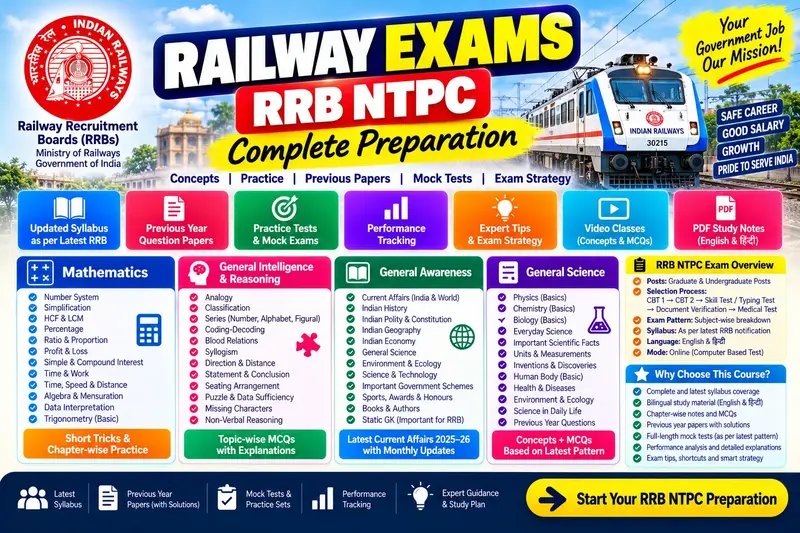
Other modules in Railway Exams Prep: RRB NTPC & Group D

Enrol free to access all lessons

Create your account in 30 seconds and start immediately.