
























Skip to content
OFFER Use code on paid courses at checkout
FREE PREVIEW Week 2 3 lessons

Colonial Rule and the Freedom Struggle

How the East India Company took power, the revolt of 1857, social reform, the Congress and Gandhian movements, the revolutionaries, and Independence in 1947.

Lessons in this module

1

Company Rule, 1857 and the Social Reformers

Lesson • 5 quiz questions

Read notes ↓
2

Congress, Partition of Bengal and the Gandhian Movements

Lesson • 5 quiz questions

Read notes ↓
3

Revolutionaries, Constitutional Acts and Independence

Lesson • 5 quiz questions

Read notes ↓

Lesson notes

1. Company Rule, 1857 and the Social Reformers

European traders arrived after 1498. The English East India Company slowly turned from a trading company into a ruling power. The revolt of 1857 ended Company rule, and reformers worked to change society from within.

From traders to rulers

  • Vasco da Gama reached Calicut in 1498. The English East India Company received its charter on 31 December 1600; it set up a factory at Surat in 1613.
  • Battle of Plassey (1757): Robert Clive defeated Siraj-ud-Daulah, Nawab of Bengal.
  • Battle of Buxar (1764) and the Treaty of Allahabad (1765) gave the Company the Diwani (revenue rights) of Bengal, Bihar and Orissa.
  • Regulating Act 1773: Warren Hastings became the first Governor-General of Bengal. Charter Act 1833 created the post of Governor-General of India (Lord William Bentinck).
  • Land systems: Permanent Settlement (Cornwallis, 1793), Ryotwari (Madras and Bombay) and Mahalwari (north-west).
  • Wellesley's Subsidiary Alliance (1798) and Dalhousie's Doctrine of Lapse (Satara 1848, Jhansi, Nagpur) expanded British control. Kittur Rani Chennamma resisted the Company in 1824.

The revolt of 1857

  • It began at Meerut on 10 May 1857; earlier, on 29 March, Mangal Pandey had attacked officers at Barrackpore.
  • An immediate cause was the new Enfield rifle cartridge, believed to be greased with cow and pig fat.
  • Leaders: Bahadur Shah Zafar (Delhi), Nana Saheb and Tantia Tope (Kanpur), Begum Hazrat Mahal (Lucknow), Rani Lakshmibai (Jhansi), Kunwar Singh (Bihar).
  • The Government of India Act 1858 ended Company rule; the British Crown took over and the Governor-General became the Viceroy (Lord Canning).
  • Historians differ on what to call it: British writers called it a 'Sepoy Mutiny', while V. D. Savarkar (1909) and many Indians called it the 'First War of Independence'.

Social and religious reformers

  • Raja Ram Mohan Roy founded the Brahmo Samaj (1828); sati was banned in 1829 under Bentinck.
  • Ishwar Chandra Vidyasagar campaigned for the Hindu Widows' Remarriage Act 1856.
  • Swami Dayanand Saraswati founded the Arya Samaj (1875). Swami Vivekananda spoke at Chicago (1893) and founded the Ramakrishna Mission (1897).
  • Jyotirao Phule founded the Satyashodhak Samaj (1873); with Savitribai Phule he opened a girls' school in Pune in 1848.
  • Sir Syed Ahmad Khan founded the Muhammadan Anglo-Oriental College at Aligarh (1875).
  • Sree Narayana Guru of Kerala worked against caste discrimination; he consecrated the Kudroli Gokarnanatha temple in Mangaluru (1912).
Quick facts
Battle of Plassey
1757
Battle of Buxar
1764
First Governor-General of Bengal
Warren Hastings, 1773
Permanent Settlement
Cornwallis, 1793
Revolt begins
Meerut, 10 May 1857
Crown rule
Government of India Act 1858
Brahmo Samaj
Raja Ram Mohan Roy, 1828
Arya Samaj
Dayanand Saraswati, 1875
Satyashodhak Samaj
Jyotirao Phule, 1873

💡 Link each reformer with an organisation and a year; exams often give the organisation and ask for the founder.

📝 5-question quiz on this lesson: enrol free to take it and track your score.

2. Congress, Partition of Bengal and the Gandhian Movements

The Indian National Congress was founded in 1885. The partition of Bengal in 1905 sparked mass protest, and from 1919 Mahatma Gandhi led three great national movements: Non-Cooperation, Civil Disobedience and Quit India.

Early nationalism

  • The INC was founded on 28 December 1885 in Bombay; A. O. Hume helped found it and W. C. Bonnerjee was its first president.
  • Moderates (Dadabhai Naoroji, G. K. Gokhale) used petitions; Extremists (Lala Lajpat Rai, Bal Gangadhar Tilak, Bipin Chandra Pal) demanded swaraj.
  • Lord Curzon partitioned Bengal (effective 16 October 1905). The Swadeshi and Boycott movement followed. The partition was cancelled in 1911.
  • The All-India Muslim League was founded at Dhaka in 1906. The Indian Councils Act 1909 (Morley-Minto) introduced separate electorates for Muslims.
  • The Congress split at Surat in 1907. Tilak's Home Rule League was started at Belgaum in April 1916; Annie Besant started another in 1916.
  • The Lucknow Pact (1916) brought Congress and the League together. The capital moved from Calcutta to Delhi (announced 1911).

Gandhi's early struggles and Non-Cooperation

  • Gandhi returned from South Africa on 9 January 1915 (now Pravasi Bharatiya Divas).
  • First satyagrahas: Champaran (indigo farmers, 1917), Kheda (1918) and the Ahmedabad mill strike (1918).
  • The Rowlatt Act (1919) allowed detention without trial. On 13 April 1919 troops under General Dyer fired on a crowd at Jallianwala Bagh, Amritsar.
  • The Non-Cooperation Movement (1920-22), linked with the Khilafat issue, asked people to boycott British courts, schools and goods.
  • Gandhi withdrew it after violence at Chauri Chaura (February 1922). The 1924 Belgaum Congress session was the only one presided over by Gandhi.

Civil Disobedience and Quit India

  • The Simon Commission (1927) had no Indian member and was met with 'Simon Go Back'. Lala Lajpat Rai died after a police lathi charge in 1928.
  • At Lahore (1929), under Jawaharlal Nehru, Congress declared Purna Swaraj (complete independence); 26 January 1930 was celebrated as Independence Day.
  • The Dandi March (12 March - 6 April 1930) to break the salt law started the Civil Disobedience Movement. The Gandhi-Irwin Pact followed in 1931.
  • Gandhi attended only the Second Round Table Conference (1931). The Poona Pact (1932) between Gandhi and B. R. Ambedkar gave reserved seats to the depressed classes in place of separate electorates.
  • After the Cripps Mission failed, the Quit India resolution was passed in Bombay on 8 August 1942, with the call 'Do or Die'.
  • Subhas Chandra Bose led the Indian National Army and formed the Azad Hind government in Singapore in October 1943.
Quick facts
INC founded
28 Dec 1885, Bombay
First INC president
W. C. Bonnerjee
Partition of Bengal
1905, Curzon; annulled 1911
Muslim League
1906, Dhaka
Jallianwala Bagh
13 April 1919
Chauri Chaura
1922
Purna Swaraj
Lahore, 1929
Dandi March
12 March 1930
Poona Pact
1932
Quit India
8 August 1942

💡 Remember the Gandhian movements as a rough 10-year rhythm: Non-Cooperation 1920, Civil Disobedience 1930, Quit India 1942.

📝 5-question quiz on this lesson: enrol free to take it and track your score.

3. Revolutionaries, Constitutional Acts and Independence

Alongside the mass movements, revolutionaries took up armed struggle. British laws of 1919 and 1935 slowly gave Indians a share in government. In 1947 India became free but was partitioned, and over 560 princely states had to be integrated.

Revolutionaries

  • Khudiram Bose was hanged in 1908 at the age of 18 after the Muzaffarpur bomb case.
  • The Ghadar Party was formed in 1913 in the USA, with its headquarters in San Francisco, by Lala Har Dayal, Sohan Singh Bhakna and others.
  • Kakori train action (1925): Ram Prasad Bismil, Ashfaqulla Khan and others of the Hindustan Republican Association.
  • Bhagat Singh and Batukeshwar Dutt threw bombs in the Central Legislative Assembly (April 1929). Bhagat Singh, Rajguru and Sukhdev were hanged on 23 March 1931.
  • Chandrashekhar Azad died in Alfred Park, Allahabad (1931). Surya Sen led the Chittagong armoury raid (1930).
  • In Karnataka, police firing at Vidurashwatha (now in Chikkaballapur district) on 25 April 1938 killed several protesters (official and unofficial counts differ); it is often called the 'Jallianwala Bagh of the South'.

Government of India Acts 1919 and 1935

  • The 1919 Act (Montagu-Chelmsford reforms) introduced dyarchy in the provinces: some subjects under Indian ministers, others reserved for the Governor.
  • It made the central legislature bicameral and extended separate electorates to more communities.
  • The 1935 Act gave provincial autonomy, proposed an All-India Federation (never formed) and dyarchy at the centre (never implemented).
  • It set up a Federal Court (1937) and divided powers into federal, provincial and concurrent lists.
  • Many features of today's Constitution, such as the Governor's office and the lists of powers, were drawn from the 1935 Act.

Independence, Partition and integration

  • The Cabinet Mission (1946) proposed a federal plan; an interim government was formed in September 1946.
  • The Mountbatten Plan (3 June 1947) accepted partition; the Indian Independence Act was passed in July 1947; India became free on 15 August 1947.
  • The Radcliffe Line divided Punjab and Bengal. Partition displaced well over ten million people; estimates of deaths range from about two hundred thousand to two million.
  • Sardar Vallabhbhai Patel, with V. P. Menon, persuaded most princely states to sign the Instrument of Accession.
  • Junagadh joined after a plebiscite (1948); Hyderabad after police action, 'Operation Polo' (September 1948); Jammu and Kashmir acceded on 26 October 1947.
  • In Mysore State, the 'Mysore Chalo' movement (1947) led to a popular government. Goa was freed from Portugal in 1961.
Quick facts
Ghadar Party
1913, San Francisco
Kakori action
1925
Bhagat Singh hanged
23 March 1931
Dyarchy in provinces
Government of India Act 1919
Provincial autonomy
Government of India Act 1935
Mountbatten Plan
3 June 1947
Operation Polo
Hyderabad, September 1948
Goa liberated
1961

💡 Remember: 1919 Act = dyarchy in provinces; 1935 Act = provincial autonomy and dyarchy proposed at the centre.

📝 5-question quiz on this lesson: enrol free to take it and track your score.

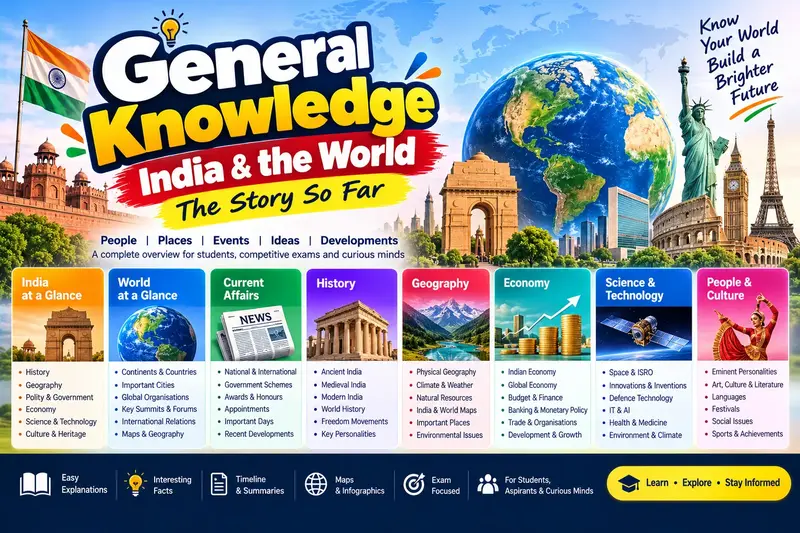
Other modules in General Knowledge: India & the World, The Story So Far

Enrol free to access all lessons

Create your account in 30 seconds and start immediately.