


































Skip to content
OFFER Use code on paid courses at checkout
FREE PREVIEW Week 1-2 4 lessons

General English: Grammar

Parts of speech, articles, prepositions, tenses, agreement, voice, narration, error spotting and fill in the blanks.

Lessons in this module

1

Parts of Speech, Articles and Prepositions

Lesson • 5 quiz questions

Read notes ↓
2

Tenses and Subject-Verb Agreement

Lesson • 5 quiz questions

Read notes ↓
3

Active and Passive Voice; Direct and Indirect Speech

Lesson • 5 quiz questions

Read notes ↓
4

Error Spotting, Sentence Correction and Fill in the Blanks

Lesson • 5 quiz questions

Read notes ↓

Lesson notes

1. Parts of Speech, Articles and Prepositions

Every English sentence is built from eight parts of speech. Exams test them directly and through articles (a, an, the) and prepositions (in, on, at, since, for). Learn the rules below with their examples.

The eight parts of speech

  • Noun: the name of a person, place, thing or idea. Example: Ravi, Mysuru, table, honesty.
  • Pronoun: used in place of a noun. Example: he, she, it, they, who, myself.
  • Verb: shows action or state. Example: run, write, is, seem. Adjective: describes a noun. Example: a tall tree, three books.
  • Adverb: describes a verb, adjective or another adverb. Example: She sings sweetly. He is very tall.
  • Preposition: shows the relation of a noun to other words. Example: on the table, in the box.
  • Conjunction: joins words or sentences (and, but, because, although). Interjection: shows sudden feeling (Oh! Alas! Hurrah!).

Articles: a, an, the

  • 'A' and 'an' are indefinite articles; 'the' is the definite article.
  • Use 'an' before a vowel SOUND, not a vowel letter: an hour, an honest man, an MLA, an umbrella.
  • Use 'a' before a consonant SOUND: a university, a European, a one-rupee coin, a useful book.
  • Use 'the' for something already mentioned or unique: the sun, the Ganga, the Himalayas, the Indian Ocean, the Bhagavad Gita.
  • Use 'the' with superlatives and ordinals: the best student, the first day.
  • No article before most names of persons, cities, languages and meals in general: She speaks Kannada. We had lunch.

Prepositions that are often tested

  • Time: 'at' for a point of time (at 6 pm), 'on' for days and dates (on Monday, on 15 August), 'in' for months, years and seasons (in May, in 2026).
  • 'Since' for a point of time (since 2020, since Monday); 'for' for a period (for three years, for two hours). Both go with the perfect tense.
  • 'Between' for two; 'among' for more than two: Divide it between the two brothers; among the five friends.
  • 'Beside' means next to; 'besides' means in addition to.
  • Fixed pairs: married to (not with), senior to (not than), prefer tea to coffee, agree with a person, agree to a proposal, interested in, good at, afraid of, depend on.
  • No preposition after these verbs: discuss the matter, reach home, enter the room, order a pizza, resemble his father.
Quick facts
an + vowel sound
an hour, an MBA, an honest officer
a + consonant sound
a university, a European, a one-way road
the + unique things
the sun, the Arabian Sea
since + point of time
since 2019
for + period
for five years
between / among
two / more than two
senior, junior, superior
+ to, never 'than'
discuss, reach, enter
no preposition after them

💡 For articles, say the word aloud. If it begins with a vowel sound, use 'an' (an hour); if it begins with a 'yu' or 'w' sound, use 'a' (a university, a one-day match).

📝 5-question quiz on this lesson: enrol free to take it and track your score.

2. Tenses and Subject-Verb Agreement

English has three main tenses (present, past, future), and each has four forms: simple, continuous, perfect and perfect continuous. Exams also check whether the verb agrees with its subject in number. These two topics give many easy marks.

The 12 tense forms with 'write'

  • Simple: I write / I wrote / I will write.
  • Continuous: I am writing / I was writing / I will be writing.
  • Perfect: I have written / I had written / I will have written.
  • Perfect continuous: I have been writing / I had been writing / I will have been writing.
  • Present simple for habits and general truths: The sun rises in the east. Water boils at 100 degrees Celsius.
  • Verbs of feeling and possession (know, like, love, believe, own, belong) are usually not used in the continuous form: I know him (not 'I am knowing him').

Tense rules that exams test

  • Present perfect is not used with a past time word: 'I saw him yesterday', not 'I have seen him yesterday'.
  • Past perfect shows the earlier of two past actions: The train had left before we reached the station.
  • In 'if' clauses about the future, use present simple, not 'will': If it rains, we will stay at home.
  • After 'since' + past time, the main clause usually uses present perfect: It has been two years since he left.
  • Do not use 'will' after time words like when, before, after, until, as soon as: I will call you when I reach (not 'when I will reach').

Subject-verb agreement

  • A singular subject takes a singular verb; a plural subject takes a plural verb: The boy plays. The boys play.
  • Each, every, either, neither, everyone, somebody take a singular verb: Each of the students has a book.
  • With 'along with', 'as well as', 'together with', the verb agrees with the first subject: The teacher, along with the students, is coming.
  • With 'either...or' and 'neither...nor', the verb agrees with the nearer subject: Neither the manager nor the clerks were present.
  • 'The number of' takes a singular verb; 'a number of' takes a plural verb: The number of cars is rising. A number of students were absent.
  • Some nouns are always plural (scissors, trousers, spectacles, cattle) and some always singular (information, furniture, luggage, advice, news).
Quick facts
Habit / general truth
Present simple: She walks daily.
Earlier of two past actions
Past perfect: had + V3
Past time word (yesterday, ago)
Simple past, not present perfect
If-clause (future)
If it rains, we will...
Each / every / neither
singular verb
A number of
plural verb
The number of
singular verb
News, information, furniture
singular, no 's'

💡 In agreement questions, first find the real subject. Cross out phrases like 'along with...', 'of the boys' or 'as well as...' and then match the verb.

📝 5-question quiz on this lesson: enrol free to take it and track your score.

3. Active and Passive Voice; Direct and Indirect Speech

Voice and narration questions follow fixed rules. Once you learn the pattern for each tense, you can convert any sentence quickly.

Active to passive: the basic method

  • Active: Subject + verb + object. Passive: Object + form of 'be' + past participle (V3) + by + subject.
  • Example: Ravi writes a letter. Passive: A letter is written by Ravi.
  • Present continuous: is/am/are + being + V3. The workers are building a bridge. A bridge is being built by the workers.
  • Perfect: has/have/had + been + V3. She has finished the work. The work has been finished by her.
  • Modals: modal + be + V3. You must obey the rules. The rules must be obeyed.
  • Pronouns change form: I to me, we to us, he to him, she to her, they to them.

Special passive patterns

  • Imperative: 'Shut the door.' becomes 'Let the door be shut.'
  • Request: 'Please help me.' becomes 'You are requested to help me.'
  • Question with who: 'Who wrote this book?' becomes 'By whom was this book written?'
  • Intransitive verbs (no object), such as sleep, go, arrive, cannot be changed into the passive.
  • If the doer is not important, it is often left out: The road was repaired last week.

Direct to indirect speech

  • If the reporting verb is in the past (said), the tense goes one step back: present simple to past simple, present continuous to past continuous, simple past to past perfect, will to would, can to could.
  • Universal truths do not change: He said, 'The earth moves round the sun.' becomes He said that the earth moves round the sun.
  • Words of nearness change: now to then, today to that day, tomorrow to the next day, yesterday to the previous day, here to there, this to that.
  • Questions: use asked + if/whether (yes/no questions) or the question word, and make it a statement: He asked me where I lived.
  • Commands: use told/ordered + to: He said to me, 'Sit down.' becomes He told me to sit down.
  • Requests: requested + to; 'Don't' becomes 'not to': She said to me, 'Please don't go.' becomes She requested me not to go.
Quick facts
Simple present passive
is/am/are + V3
Continuous passive
is/was + being + V3
Perfect passive
has/have/had + been + V3
Modal passive
can/must/should + be + V3
Imperative passive
Let + object + be + V3
said + 'I am...'
said that he was...
tomorrow / yesterday
the next day / the previous day
'Don't...' command
told ... not to ...

💡 In passive questions, check two things only: the form of 'be' matches the tense, and the main verb is in V3. In narration, check tense shift and time words.

📝 5-question quiz on this lesson: enrol free to take it and track your score.

4. Error Spotting, Sentence Correction and Fill in the Blanks

Error spotting questions split a sentence into parts and ask which part has a mistake. Most errors come from a short list of rules. Many of them are common in Indian English, so learn the correct forms below.

Common Indian-English errors

  • 'Discuss about' is wrong. Say: We discussed the plan.
  • 'Return back' and 'revert back' repeat the meaning. Say: return, reply.
  • 'Cousin brother' and 'cousin sister' are not standard. Say: my cousin.
  • 'Do one thing' is not standard. Say: Please do this.
  • Uncountable nouns have no plural: 'informations', 'furnitures', 'luggages', 'advices' are wrong.
  • 'I am having a car' is wrong for possession. Say: I have a car.

Grammar points behind most errors

  • 'One of the' + plural noun + singular verb: One of my friends is a doctor.
  • Comparatives: 'more better' is wrong; say 'better'. Use 'than' after a comparative: She is taller than her brother.
  • 'Lest' already has a negative meaning, so it is followed by 'should' (or the plain verb), never by 'not': Walk carefully lest you should fall.
  • 'Hardly' and 'scarcely' are followed by 'when'; 'no sooner' is followed by 'than': No sooner had he arrived than it began to rain.
  • Question tags: a positive sentence takes a negative tag. He is here, isn't he? She can't swim, can she?
  • After 'let', use the object pronoun: Let him go. Let you and me decide (not 'you and I').

How to attempt the questions

  • Read the whole sentence once for meaning before looking at the parts.
  • Check the subject and verb first, then tense, then articles and prepositions, then pronouns.
  • In fill in the blanks, read the words before and after the blank. Look for clues like since/for, a/an, singular/plural.
  • If no part has an error, choose 'No error' (when it is offered). Do not invent an error.
  • In sentence improvement, the correct option must fix the error without adding a new one.
Quick facts
discuss about
discuss
return back
return
cousin brother
cousin
informations
information
more better
better
lest ... not
lest ... should
no sooner ... when
no sooner ... than
hardly ... than
hardly ... when

💡 Keep a notebook of errors you make in practice tests. The same 30-40 rules appear again and again in KEA and other state exams.

📝 5-question quiz on this lesson: enrol free to take it and track your score.

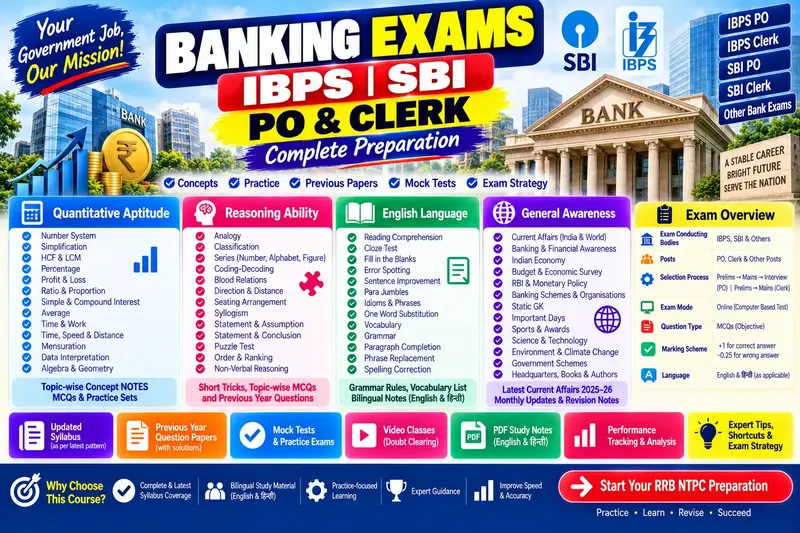
Other modules in Banking Exams Prep: IBPS & SBI PO and Clerk

Enrol free to access all lessons

Create your account in 30 seconds and start immediately.