































Skip to content
OFFER Use code on paid courses at checkout
FREE PREVIEW Week 3 3 lessons

Banking and Financial Awareness

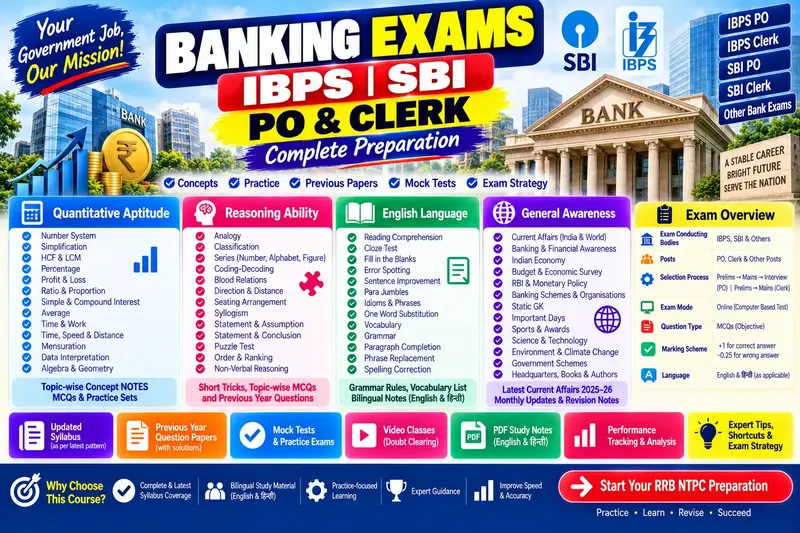
The banking section of IBPS, SBI and other bank exams: how the RBI controls money, the types of banks and development institutions, financial inclusion schemes, payment systems, regulators and stock markets, and the banking terms every candidate must know.

Lessons in this module

1

RBI Functions and Monetary Policy Tools

Lesson • 5 quiz questions

Read notes ↓
2

Banking Structure, Development Banks and Financial Inclusion

Lesson • 5 quiz questions

Read notes ↓
3

Payments, Markets, Regulators and Banking Terms

Lesson • 5 quiz questions

Read notes ↓

Lesson notes

1. RBI Functions and Monetary Policy Tools

The Reserve Bank of India (RBI), headquartered in Mumbai, is India's central bank. It controls the supply and cost of money using a set of tools. Bank exams ask what each tool means and which way it moves when the RBI wants to control inflation.

Functions of the RBI

  • Issuer of currency notes (one-rupee notes and all coins are issued by the Government of India, but distributed through the RBI).
  • Banker to the Government: it manages the accounts and borrowing of the Centre and the states.
  • Banker's bank and lender of last resort: banks keep reserves with the RBI and can borrow from it in an emergency.
  • Regulator and supervisor of banks and NBFCs, custodian of foreign exchange reserves, and manager of the Foreign Exchange Management Act (FEMA).
  • Runs and oversees payment systems such as NEFT and RTGS.

Policy rates explained

  • Repo rate: the rate at which the RBI lends short-term money to banks against government securities. It is the main policy rate, set by the Monetary Policy Committee.
  • Standing Deposit Facility (SDF): introduced in April 2022, it lets banks park extra money with the RBI without giving collateral. It is the floor of the interest-rate corridor and is kept 0.25% below the repo rate.
  • Reverse repo: the rate at which the RBI borrows from banks against securities. Since the SDF came in, the fixed reverse repo rate (3.35%) is no longer the floor and is rarely used.
  • Marginal Standing Facility (MSF): emergency overnight borrowing by banks, 0.25% above the repo rate; it is the ceiling of the corridor. The Bank Rate is kept equal to the MSF rate.
  • As of the policy of 7 October 2026, the RBI raised the repo rate by 0.25% to 5.50%, making SDF 5.25% and MSF and Bank Rate 5.75%. Always check the latest policy before your exam.

Reserve ratios and other tools

  • Cash Reserve Ratio (CRR): the share of a bank's deposits (net demand and time liabilities, NDTL) that must be kept as cash with the RBI. Banks earn no interest on it. CRR was cut in four steps (September-November 2025) to 3%.
  • Statutory Liquidity Ratio (SLR): the share of NDTL that banks must hold themselves in safe liquid assets such as cash, gold or government securities. It is 18%.
  • Open Market Operations (OMO): the RBI buys government securities to put money into the system, or sells them to take money out.
  • Qualitative tools: margin requirements on loans, selective credit control and moral suasion (persuading banks).
  • To fight inflation the RBI raises the repo rate or CRR and sells securities; to boost growth it does the opposite.
Quick facts
Repo rate (7 Oct 2026)
5.50%
SDF
Repo - 0.25% (floor)
MSF / Bank Rate
Repo + 0.25% (ceiling)
Fixed reverse repo
3.35%
CRR
3% (since late Nov 2025)
SLR
18%
SDF introduced
April 2022
Kept with RBI
CRR
Kept by the bank itself
SLR
OMO purchase
Adds money to the system

💡 Picture a corridor: SDF is the floor, MSF is the ceiling and repo sits in the middle, 0.25% away from each. If you know the repo rate, you can work out the other two.

📝 5-question quiz on this lesson: enrol free to take it and track your score.

2. Banking Structure, Development Banks and Financial Inclusion

India's banking system has many kinds of banks, each with a different purpose. The government also runs schemes so that poor and rural people can get a bank account, insurance, a pension and small loans.

Types of banks

  • Scheduled commercial banks: public sector banks (12 since the mergers of April 2020, SBI being the largest), private banks, foreign banks, small finance banks and payments banks.
  • Small finance banks take deposits and lend mainly to small businesses, farmers and low-income people.
  • Payments banks accept deposits (up to ₹2 lakh per customer) and offer payments and remittances, but they cannot give loans or issue credit cards.
  • Regional Rural Banks (RRBs) began on 2 October 1975 (the first was Prathama Bank, Moradabad). Ownership is Centre 50%, sponsor bank 35% and state 15%. Under 'One State, One RRB', they were merged to 28 from 1 May 2025.
  • Cooperative banks are owned by members and work in a three-tier system in rural areas (state, district, village level). Urban cooperative banks serve towns.

Development financial institutions

  • NABARD (12 July 1982, Mumbai): apex bank for agriculture and rural development; it refinances rural lending and supports RRBs and cooperatives.
  • SIDBI (2 April 1990, Lucknow): main institution for financing micro, small and medium enterprises (MSMEs).
  • EXIM Bank (1982, Mumbai): finances and promotes India's exports and imports.
  • National Housing Bank (1988, New Delhi): promotes and refinances housing finance companies. NaBFID (2021) funds infrastructure.

Financial inclusion schemes

  • PM Jan Dhan Yojana (2014): zero-balance account with a RuPay debit card, accident cover (₹2 lakh for accounts opened after 28 August 2018) and an overdraft of up to ₹10,000.
  • PM Jeevan Jyoti Bima Yojana (PMJJBY, 9 May 2015): life cover of ₹2 lakh for ages 18-50 at ₹436 a year.
  • PM Suraksha Bima Yojana (PMSBY, 9 May 2015): accident cover of ₹2 lakh for ages 18-70 at ₹20 a year.
  • Atal Pension Yojana (APY, 9 May 2015): for ages 18-40, gives a guaranteed pension of ₹1,000 to ₹5,000 a month after 60; it is run by PFRDA.
  • PM Mudra Yojana (April 2015): loans to small non-farm businesses in categories Shishu (up to ₹50,000), Kishore (up to ₹5 lakh), Tarun (up to ₹10 lakh) and Tarun Plus (up to ₹20 lakh, added in 2024).
  • Stand-Up India (April 2016): bank loans of ₹10 lakh to ₹1 crore for SC/ST and women entrepreneurs to start a new (greenfield) business.
Quick facts
Public sector banks
12 (since April 2020)
RRB start
2 Oct 1975
RRB share
Centre 50 : Sponsor 35 : State 15
RRBs after merger
28 (from 1 May 2025)
Payments bank deposit limit
₹2 lakh
NABARD
1982, Mumbai
SIDBI
1990, Lucknow
PMJJBY premium
₹436/year
PMSBY premium
₹20/year
APY pension
₹1,000-5,000/month
Mudra Tarun Plus
up to ₹20 lakh

💡 For the 2015 trio, remember life vs accident: PMJJBY = Jeevan = life (₹436), PMSBY = Suraksha = accident (₹20). Both give ₹2 lakh cover.

📝 5-question quiz on this lesson: enrol free to take it and track your score.

3. Payments, Markets, Regulators and Banking Terms

This lesson covers how money moves electronically in India, who regulates insurance, pensions and the stock market, how the stock exchanges work, and the short forms and terms that appear in every bank exam.

Payment systems

  • NEFT (run by the RBI) settles in half-hourly batches and has worked 24x7 all year since December 2019. There is no minimum amount.
  • RTGS (run by the RBI) settles each payment immediately and one by one. The minimum is ₹2 lakh; it has been available 24x7 since 14 December 2020.
  • NPCI (Mumbai) runs IMPS (instant transfer, 24x7), UPI, RuPay cards (2012), NACH (bulk payments like salaries), AePS (Aadhaar-based payments), Bharat BillPay and NETC FASTag.
  • UPI 123PAY lets feature-phone users make UPI payments; UPI Lite is for small payments without entering a PIN each time.
  • Cheque Truncation System (CTS) clears cheques using images instead of moving the paper cheque.

Regulators and markets

  • SEBI regulates the securities market. It was set up in 1988 and given legal powers in 1992; its HQ is in Mumbai.
  • IRDAI (Hyderabad) regulates insurance under the IRDA Act 1999. PFRDA (New Delhi) regulates pensions, including the National Pension System (NPS) and APY.
  • BSE (1875) is Asia's oldest stock exchange; its main index, the Sensex, has 30 companies. NSE (1992) runs the Nifty 50 index of 50 companies.
  • Primary market: companies sell new shares, for example through an IPO. Secondary market: investors trade existing shares on an exchange.
  • Indian equity trades now settle on T+1 (the next working day). Depositories that hold shares electronically are NSDL and CDSL.

Banking terms glossary

  • NPA (non-performing asset): a loan whose interest or principal has been overdue for more than 90 days.
  • CASA: Current Account and Savings Account deposits. A high CASA ratio means cheaper funds for a bank.
  • KYC (Know Your Customer): checking a customer's identity and address before opening an account. Basel III: global rules on how much capital and liquidity banks must hold.
  • Priority Sector Lending (PSL): banks must lend a set share (40% of adjusted net bank credit for domestic commercial banks) to sectors like agriculture, MSMEs, education and housing.
  • CRAR (capital to risk-weighted assets ratio) measures a bank's strength. SARFAESI Act (2002) and the Insolvency and Bankruptcy Code (2016) help recover bad loans.
  • DICGC insures bank deposits; in February 2020 the cover was raised from ₹1 lakh to ₹5 lakh per depositor per bank (a further increase has been under discussion, so check the current limit). MCLR is the internal benchmark lending rate of a bank.
Quick facts
NEFT
Half-hourly batches, 24x7
RTGS minimum
₹2 lakh
RTGS 24x7 from
14 Dec 2020
RuPay
NPCI, 2012
SEBI HQ
Mumbai
IRDAI HQ
Hyderabad
PFRDA HQ
New Delhi
Sensex
BSE, 30 stocks
Nifty
NSE, 50 stocks
NPA
Overdue > 90 days
CASA
Current + Savings
PSL target
40% of ANBC

💡 Short forms are free marks: write the full form of every banking abbreviation you meet (NEFT, RTGS, IMPS, NACH, CRAR, MCLR, SARFAESI) in one notebook and revise it weekly.

📝 5-question quiz on this lesson: enrol free to take it and track your score.

Other modules in Banking Exams Prep: IBPS & SBI PO and Clerk

Enrol free to access all lessons

Create your account in 30 seconds and start immediately.