

























Skip to content
OFFER Use code on paid courses at checkout
FREE PREVIEW Week 1 2 lessons

Start Here: KARTET (Karnataka Teacher Eligibility Test)

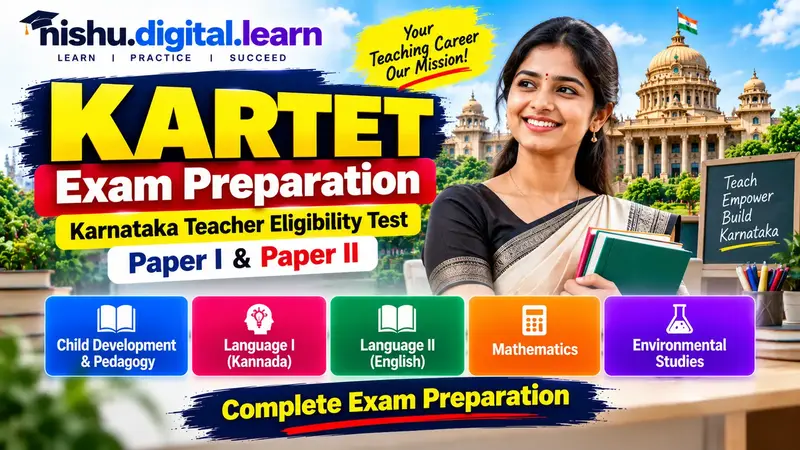
Understand KARTET Paper I and Paper II, who can take them, the sections and marks, pass marks, certificate validity, and how to prepare.

Lessons in this module

1

KARTET: Papers, Eligibility and Pattern

Lesson • 5 quiz questions

Read notes ↓
2

KARTET: Study Plan and Exam Technique

Lesson • 5 quiz questions

Read notes ↓

Lesson notes

1. KARTET: Papers, Eligibility and Pattern

The Karnataka Teacher Eligibility Test (KARTET) is conducted by the Department of School Education, Government of Karnataka. Passing it is an eligibility condition for teacher posts in classes 1 to 8 in Karnataka. It is not a recruitment exam by itself: you still need to apply and be selected in a teacher recruitment. The last test was KARTET 2025, held on 7 December 2025. This lesson follows the standard NCTE-based pattern; check the notification for your year.

The two papers and who can take them

  • Paper I (Primary level) is for teaching classes 1 to 5. Paper II (Upper primary level) is for teaching classes 6 to 8.
  • You can take one paper or both, if you are eligible for both.
  • For Paper I, candidates broadly need 2nd PUC with a Diploma in Elementary Education (D.El.Ed), or as allowed under NCTE rules.
  • For Paper II, candidates broadly need a degree with D.El.Ed or B.Ed, or as allowed under NCTE rules. Final-year trainees are usually allowed to appear.
  • In 2025 Paper I was held from 9.30 am to 12 noon and Paper II from 2 pm to 4.30 pm on the same day.

Pattern of each paper

  • Each paper has 150 multiple-choice questions of 1 mark each (150 marks) and lasts 2 hours 30 minutes. Answers are marked on an OMR sheet.
  • There is no negative marking.
  • Paper I: Child Development and Pedagogy 30, Language I 30, Language II 30, Mathematics 30, Environmental Studies 30.
  • Paper II: Child Development and Pedagogy 30, Language I 30, Language II 30, and either Mathematics and Science 60 (for Maths/Science teachers) or Social Studies 60 (for Social Studies teachers).
  • Language I and Language II must be different. Kannada and English are the common choices; check the notification for the full list of languages.

Pass marks and certificate

  • General candidates need 60% (90 out of 150) to pass.
  • Recent Karnataka notifications allow 55% (83 out of 150) for SC, ST, Category-1 and candidates with disabilities. Confirm the list in your notification.
  • Following the NCTE decision of 2021, TET certificates are valid for life. Recent reports on KARTET also describe the certificate as valid for life.
  • There is no limit on attempts; you can appear again to improve your score.
  • Official website: schooleducation.karnataka.gov.in (notifications, applications, admit cards and results).
Quick facts
Paper I
Classes 1 to 5
Paper II
Classes 6 to 8
Each paper
150 MCQs, 150 marks, 2 hours 30 minutes
Negative marking
None
Pass mark
60% general; 55% for notified reserved groups
Certificate
Valid for life (NCTE 2021)
Website
schooleducation.karnataka.gov.in

💡 Since there is no negative marking in KARTET, never leave a question blank. If you are unsure, make your best guess.

📝 5-question quiz on this lesson: enrol free to take it and track your score.

2. KARTET: Study Plan and Exam Technique

KARTET tests both what you know and how you would teach it. About one fifth of each paper is Child Development and Pedagogy, and many subject questions also ask about teaching methods. This lesson shows how to plan and how the modules in this series help.

How the course modules map to the syllabus

  • Child Development and Pedagogy: the Child Development and Pedagogy: Development module (growth, learning theories such as Piaget and Vygotsky) and the Child Development and Pedagogy: Inclusive Education and Teaching module (inclusion, assessment, classroom practice).
  • Subject-teaching methods: the Pedagogy of Language, Mathematics and EVS module, for the pedagogy questions inside the language, Maths and EVS sections.
  • Language I and II content: the General Kannada and General English modules for grammar, vocabulary and comprehension.
  • Mathematics content: the Quantitative Aptitude modules for number skills; also revise school textbook chapters of classes 1 to 8.
  • EVS (Paper I), Science and Social Studies (Paper II): General Science, Environment and Ecology, the history modules, Geography of India and Karnataka, and The Constitution of India.

An 8-week plan

  • Weeks 1 and 2: Child Development and Pedagogy, one theory or topic each day.
  • Weeks 3 and 4: your two languages: grammar, comprehension and language-teaching methods.
  • Weeks 5 and 6: Maths and EVS (Paper I) or your Paper II subject, using Karnataka state textbooks of classes 1 to 8.
  • Weeks 7 and 8: full 150-question mock tests in 2 hours 30 minutes, then revision.
  • If you take both papers, study the common parts (pedagogy and languages) once and use them for both.

Exam-hall technique

  • You get 150 minutes for 150 questions, about 1 minute per question.
  • Answer every question; there is no negative marking.
  • In pedagogy questions, choose the answer that is child-centred, inclusive and encourages understanding over rote learning.
  • Fill the OMR sheet with a blue or black ballpoint pen, as instructed, and check the paper and booklet code.
Quick facts
CDP
Child Development and Pedagogy: 30 marks in each paper
Time per question
About 1 minute
Blank answers
Never: no negative marking
Pedagogy answers
Child-centred and inclusive
Best textbooks
Karnataka state textbooks, classes 1 to 8

💡 Solve at least three previous KARTET papers. They show how pedagogy questions are framed, which is very different from GK exams.

📝 5-question quiz on this lesson: enrol free to take it and track your score.

Other modules in KARTET Prep: Karnataka Teacher Eligibility Test (Paper I & II)

Enrol free to access all lessons

Create your account in 30 seconds and start immediately.