



























Skip to content
OFFER Use code on paid courses at checkout
FREE PREVIEW Week 3 2 lessons

Physical Test Preparation and Exam Strategy

What the physical tests usually include, how to train safely, and how to plan for the written exam, documents and verification.

Lessons in this module

1

Understanding PET and PST, and Training Safely

Lesson • 5 quiz questions

Read notes ↓
2

Written Exam Strategy and Document Verification

Lesson • 5 quiz questions

Read notes ↓

Lesson notes

1. Understanding PET and PST, and Training Safely

Police recruitment has physical tests along with the written exam. The exact events, distances, times and heights change from one notification to another and differ by post, category and gender. Always read the latest official notification on the Karnataka State Police recruitment website before you train for numbers.

What the tests are

  • PST (Physical Standard Test) checks body measurements such as height, chest or weight, as listed for each gender in the notification. Some categories get relaxation as per rules.
  • PET or ET (Physical/Endurance Test) checks fitness through events. Usually these are qualifying in nature.
  • Common events in police tests include an endurance run, long jump, high jump and shot put. Not every post uses every event.
  • Standards for men and women are different, and posts like CPC, DAR and KSRP may have different rules.
  • Measurements are taken by a board on test day. Carry your admit card and report on time.

Safe training principles

  • Warm up for 10 to 15 minutes before running or jumping: light jogging, then stretching and mobility exercises.
  • Progressive overload: increase distance, speed or weight slowly, a little at a time. Sudden jumps in training often cause injury.
  • Rest is part of training. Take at least one easy or rest day each week and sleep 7 to 8 hours.
  • Drink enough water, especially in hot weather, and eat simple, balanced food with enough protein.
  • Cool down and stretch after training. Use proper running shoes and a flat, safe surface.

Avoiding injury and practising events

  • Learn correct technique for long jump, high jump and shot put from a trained coach or senior; technique matters as much as strength.
  • Stop training and get medical advice if you have chest pain, dizziness, or sharp joint pain.
  • Practise the actual event under test-like conditions a few times before the test, but do not over-train in the final week.
  • Never use banned drugs or unknown supplements to improve performance. They are unsafe and can lead to disqualification.
Quick facts
PST
Physical Standard Test - body measurements
PET / ET
Physical or Endurance Test - fitness events, usually qualifying
Warm-up
Light jogging and mobility before training
Progressive overload
Increase training load slowly over time
Recovery
Rest days, sleep, water and balanced food
Official source
Latest KSP recruitment notification

💡 Write down the exact standards from the current notification for your post, category and gender, and test yourself every two weeks. Train to beat the standard comfortably, not just touch it.

📝 5-question quiz on this lesson: enrol free to take it and track your score.

2. Written Exam Strategy and Document Verification

The written exam is usually an objective (multiple-choice) test on an OMR sheet. Read the syllabus, marks, time and negative marking rules in your notification. A clear plan and correct documents can make the difference between selection and rejection.

Planning your study

  • Collect the official syllabus and previous question papers. Note which topics come again and again.
  • Typical areas: general knowledge, current affairs, Karnataka-specific facts, mental ability and reasoning, basic arithmetic, and general science. Check your notification for the exact list.
  • Study daily in short blocks. Revise every Sunday. Keep one notebook for facts like Acts, years and articles.
  • Read a daily newspaper in Kannada or English for current affairs, and follow official sources such as PIB.
  • Take timed mock tests on OMR sheets to build speed and accuracy.

In the examination hall

  • Reach early with your admit card and a valid photo ID. Follow all instructions on what you may carry.
  • Fill your roll number and booklet series on the OMR sheet carefully with the correct pen; mistakes here can cancel your paper.
  • Answer the easy questions first, then return to harder ones. Do not spend too long on a single question.
  • If there is negative marking, avoid blind guessing; guess only when you can remove two or more wrong options.

Documents and verification

  • Keep originals and photocopies ready: SSLC/PUC marks cards, date of birth proof, caste and income certificate, Kannada medium or rural study certificate if claimed, and photos.
  • Certificates for reservation must be in the format and date range given in the notification.
  • Details in the online application must match your documents exactly; wrong details can lead to rejection.
  • Selected candidates go through medical examination and police verification of character and antecedents.
  • Never give false information or fake certificates. It is a criminal offence and leads to cancellation of selection.
Quick facts
OMR
Answer sheet read by machine - fill roll number and series carefully
Negative marking
Guess only after removing wrong options
Admit card + photo ID
Carry to every test
Documents
Originals and copies: marks cards, DOB proof, caste/income and other claimed certificates
After selection
Medical examination and character verification
Fake certificate
Criminal offence; selection cancelled

💡 Make a checklist of every document named in the notification and tick each one weeks before the verification date, so you have time to get missing certificates.

📝 5-question quiz on this lesson: enrol free to take it and track your score.

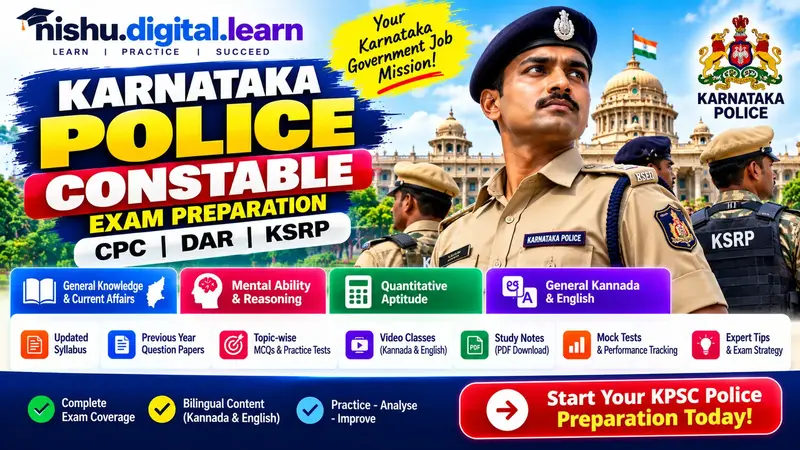
Other modules in Karnataka Police Constable Exam Prep (CPC, DAR, KSRP)

Enrol free to access all lessons

Create your account in 30 seconds and start immediately.