





















1. SSC CGL, CHSL and MTS: Posts, Eligibility and Exam Pattern
The Staff Selection Commission (SSC) recruits staff for central government ministries, departments and offices. Its three biggest exams are CGL, CHSL and MTS. All of them are computer-based tests (CBT) with multiple-choice questions. This lesson explains the pattern as given in the recent (2025-26) notifications. Patterns can change in any year, so always read the official notification for your exam cycle on ssc.gov.in before you start.
What each exam recruits for and who can apply (broad picture)
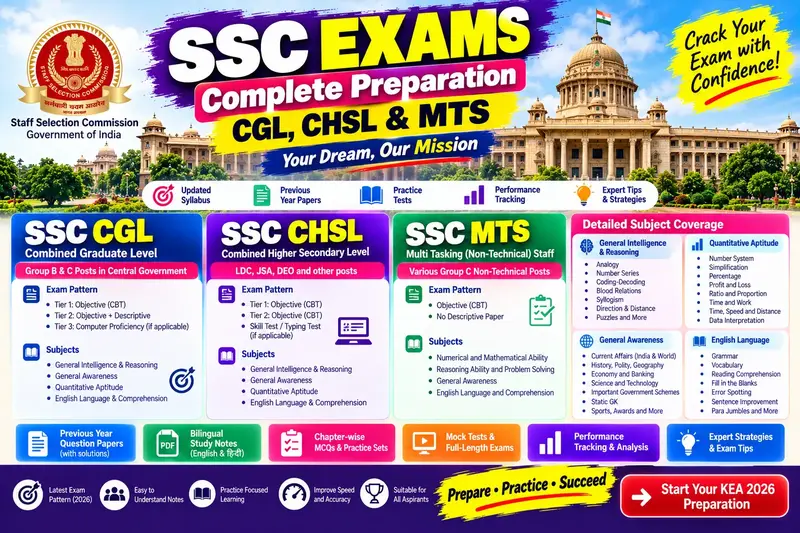
- CGL (Combined Graduate Level): Group B and Group C posts such as Assistant Section Officer, Inspector (Income Tax, GST, Excise), Auditor, Accountant and Junior Statistical Officer. You need a bachelor's degree.
- CHSL (Combined Higher Secondary Level): posts such as Lower Division Clerk (LDC/JSA), Postal Assistant/Sorting Assistant and Data Entry Operator (DEO). You need to have passed Class 12.
- MTS (Multi-Tasking Staff) and Havaldar (CBIC and CBN): support staff posts. You need to have passed Class 10.
- The minimum age is usually 18. The upper limit depends on the post, roughly from the mid-20s to early 30s, with relaxation for reserved categories.
- Exact age limits, cut-off dates and educational conditions are given post-wise in each notification. Check them carefully before applying.
SSC CGL pattern (recent notifications)
- Tier 1 is qualifying only: 100 questions, 200 marks, 60 minutes in total. Four sections of 25 questions each: Reasoning, General Awareness, Quantitative Aptitude and English Comprehension. Recent notices may give each section its own timer, so check your cycle.
- Tier 1 has negative marking of 0.50 for each wrong answer (each question carries 2 marks).
- Tier 2 Paper I is for everyone and decides the merit: Mathematics, Reasoning, English and General Awareness, plus a Computer Knowledge module and a Data Entry Speed Test (DEST). Each question carries 3 marks and 1 mark is cut for a wrong answer.
- You must clear the Computer Knowledge module and the DEST. How their marks are counted (qualifying only or added to merit) is set in each notification, so check your cycle.
- Separate papers exist only for some posts: Statistics for Junior Statistical Officer, and a Finance and Economics paper for some audit/accounts posts.
SSC CHSL and MTS pattern (recent notifications)
- CHSL Tier 1: same shape as CGL Tier 1, with 100 questions, 200 marks, 60 minutes, four sections and 0.50 negative marking.
- CHSL Tier 2, Session I: Mathematics and Reasoning, then English and General Awareness, then a Computer Knowledge module. One mark is cut for each wrong answer.
- CHSL Tier 2, Session II: a qualifying skill test for DEO posts and a typing test for LDC/JSA posts, both done on a computer.
- MTS has one CBT in two sessions on the same day. Session I is Numerical Ability and Reasoning (no negative marking). Session II is General Awareness and English (1 mark cut per wrong answer).
- MTS has 90 questions for 270 marks in total. Havaldar candidates also take a Physical Efficiency Test (walking) and a Physical Standard Test (height, chest/weight).
Normalisation and the computer-based test
- SSC holds each CBT in many shifts over several days. Some shifts may be a little easier or harder than others.
- To be fair, SSC converts raw marks into normalised marks using a statistical formula. So your final score can be slightly different from your raw score.
- Because of normalisation, do not worry about the difficulty of your own shift. Just attempt as many questions as you can answer correctly.
- The CBT shows a question palette. You can mark questions for review and move between questions in a section freely.
- Practise full mock tests on a computer, not only on paper, so that the screen layout feels familiar on exam day.
Quick facts
- CGL
- Graduate; Tier 1 qualifying + Tier 2 merit
- CHSL
- Class 12 pass; Tier 1 + Tier 2 with skill/typing test
- MTS / Havaldar
- Class 10 pass; one CBT in 2 sessions (+ PET/PST for Havaldar)
- Tier 1 (CGL/CHSL)
- 100 Q, 200 marks, 60 min, -0.50
- Tier 2 (CGL/CHSL)
- 3 marks per question, -1 per wrong
- MTS Session I
- No negative marking
- Normalisation
- Adjusts scores across shifts
💡 Read the post-wise eligibility table in the notification before you fill the form. Many candidates lose a year because of an age or education condition they missed.
📝 5-question quiz on this lesson: enrol free to take it and track your score.