




























1. The KEA Exam Pattern for Group C Posts
The Karnataka Examinations Authority (KEA) conducts recruitment exams for many Karnataka government posts, such as Village Administrative Officer (VAO), First and Second Division Assistants (FDA/SDA) for some departments, and other Group C posts. This lesson explains the pattern used in the 2026 VAO notification. Patterns can change from post to post, so always check the official notification for your post.
Stage 1: Compulsory Kannada Language Test
- Candidates who must take it write a Kannada Language Test of 150 marks before (or along with) the main written exam.
- It is a qualifying test only. As reported for 2026, the pass mark was 50 out of 150. Its marks are not added to the merit list.
- Candidates who studied Kannada as a first or second language up to SSLC, or passed SSLC or a higher exam in Kannada medium, are generally exempt.
- Candidates who have already passed an approved Kannada language test are also usually exempt. Check the exact exemption rules in your notification.
- Failing this test means you are not selected, even if your written exam score is high.
Stage 2: Two objective papers
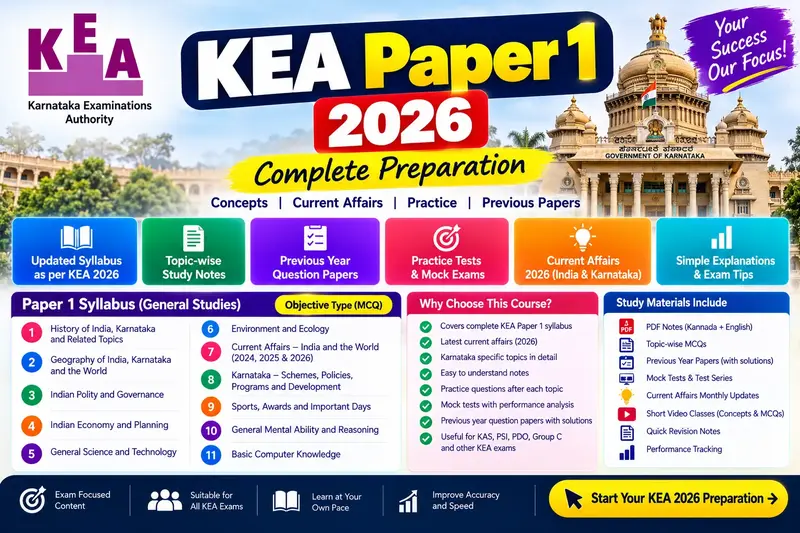
- Paper 1, General Knowledge: 100 questions, 100 marks, 2 hours. This course is written for Paper 1.
- Paper 1 covers current affairs, Indian history, the Constitution, geography, economy, Karnataka history and geography, and Panchayat Raj and rural development.
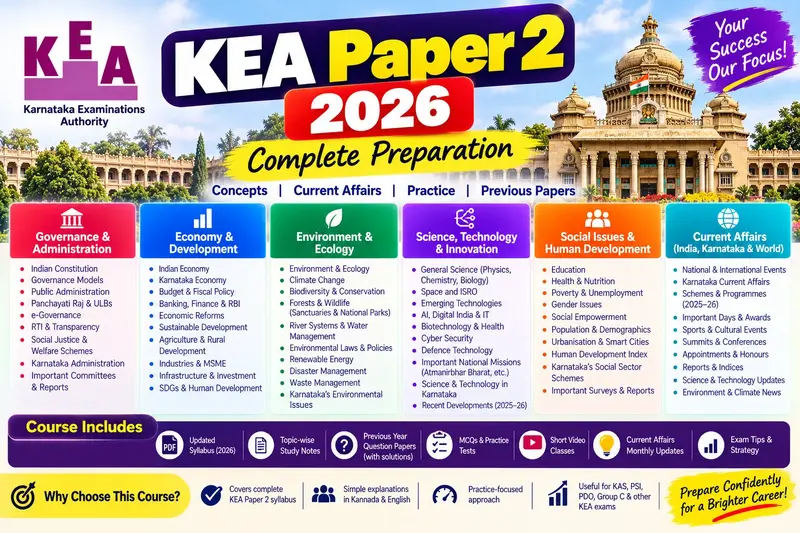
- Paper 2: General Kannada (35 marks), General English (35 marks) and Computer Knowledge (30 marks): 100 questions, 100 marks, 2 hours.
- Both papers are objective multiple-choice questions with four options, answered on an OMR sheet. Question papers are usually given in both Kannada and English.
- For every wrong answer, 0.25 (one quarter) mark is deducted. There is no deduction for a question you leave blank.
- Merit is based on the total of Paper 1 and Paper 2 (200 marks), as per the notification.
Where to get official information
- KEA's official website is kea.kar.nic.in. Notifications and online applications are also published on the KEA portal at cetonline.karnataka.gov.in/kea.
- Download the notification PDF for your post and read the syllabus, eligibility, age limit, reservation and document rules carefully.
- Admit cards, provisional answer keys and results are released on the KEA website. You can object to a provisional answer key within the time allowed.
- Beware of fake websites and social media posts. Trust only the official KEA site and the notification.
How this course fits the syllabus
- This course covers the Karnataka-specific part of Paper 1: state administration, revenue administration, Panchayat Raj, the Karnataka economy, rural development, co-operatives and Karnataka current affairs.
- For national and world current affairs, use our free Current Affairs 2025: India & World and Current Affairs 2026: India & World courses.
- For Indian history, the Constitution and economy, use our free General Knowledge: India & the World course.
- For Paper 2, use our free KEA Paper 2: General Kannada, English & Computer Knowledge course.
Quick facts
- Kannada Language Test
- 150 marks, qualifying only; marks not counted for merit
- Paper 1
- General Knowledge: 100 questions, 100 marks, 2 hours
- Paper 2
- Kannada 35 + English 35 + Computer Knowledge 30 = 100 marks, 2 hours
- Negative marking
- 0.25 mark deducted per wrong answer; blank = 0
- Answer sheet
- OMR, objective multiple choice, four options
- Official website
- kea.kar.nic.in (KEA portal: cetonline.karnataka.gov.in/kea)
💡 Print the syllabus page of your notification and keep it on your study table. Tick each topic as you finish it in this course.
📝 5-question quiz on this lesson: enrol free to take it and track your score.